
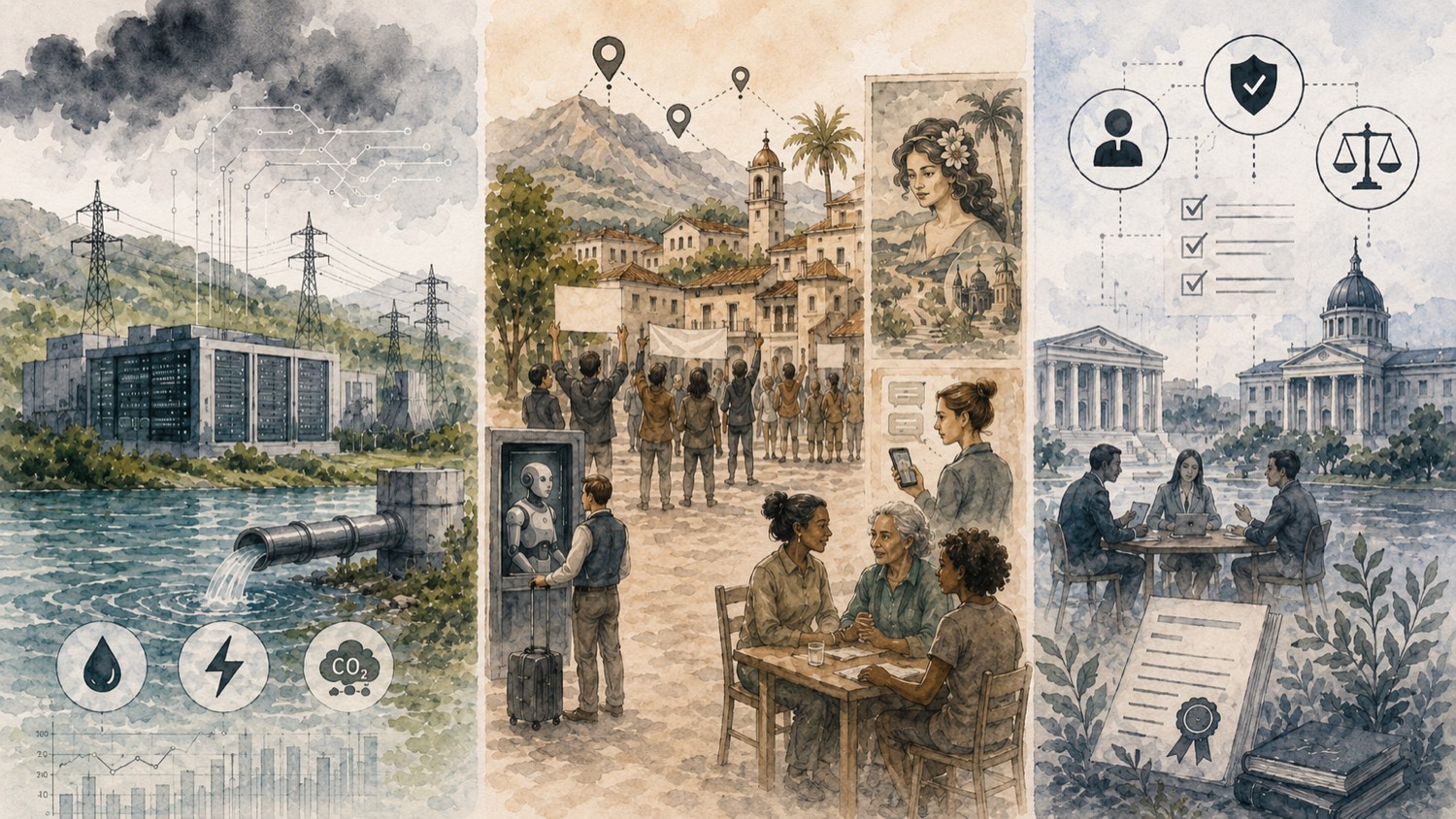
A 25-person team using a major AI provider’s most powerful model for everyday work generates roughly 2,780 kg of CO₂ and uses about 14,280 liters (3,770 gallons) of water in a year. That is the emissions of nearly 28 one-way flights from San Francisco to Los Angeles, and enough water for around 240 showers. None of it shows up on the subscription invoice.
The first post in this series argued that businesses are not behind on AI adoption. They are behind on responsible adoption. This post puts numbers on the total cost of using AI: three categories of impact most businesses are not yet tracking. Each one produces real costs. Each has something you can do about it.
Environmental impact
AI’s environmental footprint comes in three connected forms: energy, water, and greenhouse gas emissions. AI runs on data centers, which need electricity to power the chips and water to cool them. The electricity carries its own emissions and water footprint depending on whether the local grid runs on coal, gas, hydro, or renewables.
It helps to separate two moments where the impact happens: training the model (a one-time cost spread across billions of later uses) and inference (the ongoing cost every time someone uses it). Training is a single massive spike, but inference is the steady tide. For popular AI services at scale, recent research suggests inference accounts for up to 90% of total lifetime energy use. Training gets the headlines. Inference is what your business actually influences with day-to-day choices, and it is where most of the impact lives.
Most of this is invisible at the user level. You pay a flat monthly fee. The energy, water, and emissions do not appear on the bill. They are real, just absorbed by the data center operator and the community around it.
The 25-person scenario above comes from the AI Environmental Impact Calculator I built. The inputs: North America as the region, OpenAI’s most powerful model tier, 30 prompts per day per person, across a 25-person team. You can reproduce it with the same inputs, or enter your own.
One input in particular shows how a single choice changes the picture. If that same team switched to the same provider’s basic model tier for routine work, the footprint would fall by roughly 90% across the board. Same provider, same tasks, a fraction of the footprint.
This is where AI users have the most direct control. Frontier-tier models, the most powerful option each provider offers, can use roughly 14 to 24 watt-hours per query, more for extended reasoning or long-context work. A basic-tier model handling routine tasks can use under two. The default most people select is rarely the most efficient option for the actual job. Most everyday business work (drafting copy, summarizing, basic analysis, customer-facing chat) is well-served by basic and mid-tier models. Reaching for frontier reasoning every time is the equivalent of taking a transcontinental flight to visit the next town over.
The first move is to run your team’s real usage through the calculator to size your impact. The second is to match capability to task. Not every prompt needs the most powerful model on the menu. Two more levers help. Providers vary substantially in efficiency, and the gap between those that publish per-query environmental data and those that do not is itself a useful signal: Stanford’s 2025 Foundation Model Transparency Index found that 10 of 13 major AI companies disclosed none of the key environmental metrics. Choosing providers that disclose, and weighing their footprint when capability is comparable, is a real lever. The last is prompt and output discipline: shorter prompts, tighter responses, reusing context where you can. Together those can cut footprint another 20 to 40% beyond the model-tier choice.
These are estimates. Actual impact varies by infrastructure, region, prompt complexity, and model updates. The calculator is a starting point for understanding scale and relative differences, not a precise meter. The point is the order of magnitude, and how much your choices move it.
Social impact
Social impact is harder to measure than environmental impact, which is part of why it gets skipped. For most businesses, three pieces matter: how AI affects your workforce, how its infrastructure competes with the communities you operate in, and how bias shows up in the content AI produces for you.
Workforce. The roles most exposed to AI are concentrated in clerical, administrative, customer-support, and content-production work, and the people in them often have the least support to adapt. A 2026 Brookings analysis found that the U.S. workers most exposed to AI displacement and least equipped to adapt are 86% women, concentrated in clerical and administrative roles in smaller metropolitan areas. What a business can do here is limited but not zero: name the most-exposed roles in your organization, plan intentional transition support, and invest in cross-training and the skills AI does not replicate well (judgment, relationships, context).
Resource competition. Data center buildout has become increasingly contested across North America. Google’s facility in The Dalles, Oregon drew a public fight over how much of the city’s water it draws. Communities in Arizona, Texas, Utah, Virginia’s “Data Center Alley,” and around newer builds like Memphis have pushed back on the water and power that data centers pull from local grids, sometimes in regions already under water stress. The infrastructure your AI tools depend on competes for the same water and energy your community and customers need. A business operating in an affected region, especially one with public commitments to sustainability or community wellbeing, has standing to weigh in on whether that buildout fits the place.
Bias in your content. Generative AI inherits the biases of its training data. When you ask it to produce marketing imagery, write customer personas, or draft copy, the defaults reflect what the training data overrepresents, which tends to be western, white, young, able-bodied, and affluent. This one is squarely within your control. Reviewing AI-made imagery and copy for stereotyping before it ships, testing outputs across prompts to surface the defaults, being explicit about the diversity you want represented, and having people from a community review content about that community are all things you can do today. The same applies to AI in hiring, where a screening tool can quietly encode bias, and where the vendor’s tool being at fault is not a defense. For businesses working with Indigenous communities, frameworks like OCAP, from the First Nations Information Governance Centre in Canada, and the CARE Principles for Indigenous Data Governance apply directly.
There is a second kind of bias worth naming, because it cuts the other way. AI assistants increasingly shape what customers discover, and they concentrate their recommendations on the options that are easiest to describe and have the most existing content online. A business that does not actively shape how AI describes it can quietly become invisible to those systems, while better-documented competitors get surfaced by default. Shaping how AI represents your business is becoming part of being found at all.
Governance impact
Governance is the impact category most businesses have not yet recognized as a category. It shows up as legal liability, reputational damage, regulatory exposure, and decisions made by people without the authority to make them.
The clearest example is Air Canada. In 2024, a Canadian tribunal ruled the airline responsible for incorrect guidance its AI chatbot gave a customer. Its defense, that the chatbot was effectively a separate entity, failed in court and in public opinion. The airline had to compensate the customer and absorbed reputational damage that outlasted the ruling. The precedent: an organization is accountable for what its AI tells customers, whether or not a human reviewed the output first.
The pattern repeats. Workday is facing a class action over AI screening tools that allegedly rejected older applicants at higher rates. McDonald’s left the records of tens of millions of job applicants exposed when its AI hiring chatbot turned out to be protected by a default admin username and password of 123456.
Regulation is real and moving. In the U.S. there is no comprehensive federal AI law yet, but a fast-growing patchwork of state rules, with Colorado’s AI Act among the first to put duties on businesses deploying higher-risk AI. Canada’s federal attempt stalled in early 2025. The EU AI Act’s transparency requirements for AI-generated content, deepfakes, and chatbots take effect in 2026, with penalties up to €15 million or 3% of global annual turnover, and they apply to any business marketing into the EU regardless of where it is based. The specific rules will keep shifting. The fact of exposure will not.
What a business can do here starts with three questions:
- Who reviews AI outputs before they reach customers, partners, or the public?
- Who is accountable when AI produces something harmful?
- What gets logged, so you have a record of what the AI did and on whose authority?
Most businesses cannot yet answer any of these. Working through them is the foundation of an AI governance framework that holds up under both legal scrutiny and public trust.
Why use AI at all?
We just laid out real costs across three categories. The size of them raises a fair question: if AI is this expensive in human and environmental terms, why use it at all?
The only honest reason to use a technology with these costs is that it delivers greater benefits, shared fairly. AI is genuinely powerful, with meaningful uses across science, medicine, climate, and access to expertise that would not otherwise reach the people who need it. None of that erases the costs.
So I keep wrestling with whether we should use it, and I think the wrestling is part of responsible adoption. For my own practice, the calculator estimates my annual AI usage at 51.7 kg of CO₂ (roughly half a one-way flight from San Francisco to Los Angeles) and 266 liters of water (about four eight-minute showers). Those numbers are not catastrophic. They are not nothing either. Being able to quantify them helps me keep making informed decisions.
Here are three positions you could take. Oppose AI completely and abstain. Adopt it without accounting for the costs. Or adopt it as a deliberate practice: counting what it costs, reducing what can be reduced, and pushing at the systems level for the infrastructure and accountability that individual choices cannot deliver on their own.
The first is clean. The second is convenient. The third asks you to weigh AI’s usefulness against its costs. The next post is about how to operate from that third position when the technology, the costs, and the rules keep moving. Specific answers age fast. A clear framework for deciding holds up better.